
Product quizzes and product advisors are often treated as the same thing. Both ask questions. Both guide shoppers. Both can end with a recommendation.
But the goal is not always the same. A marketing quiz is usually built for attention, leads or segmentation. A product quiz helps shoppers move toward a relevant product or category. A product advisor goes deeper: it helps someone make a buying decision with questions, product data, matching logic and a clear explanation.
For ecommerce owners, that difference matters. If you use a light quiz for a complex decision, the result can feel shallow. If you build a heavy advisor for a simple campaign, the experience may feel slower than it needs to be.
The short version
A product quiz is a short question flow that connects a shopper to a product, product group, routine or profile. For example: "Which skincare routine fits you?" or "Which coffee machine should you choose?"
A choice helper for webshops or advice flow is more decision-focused. It guides a shopper through practical questions about use case, size, budget, compatibility, material, preference or constraints.
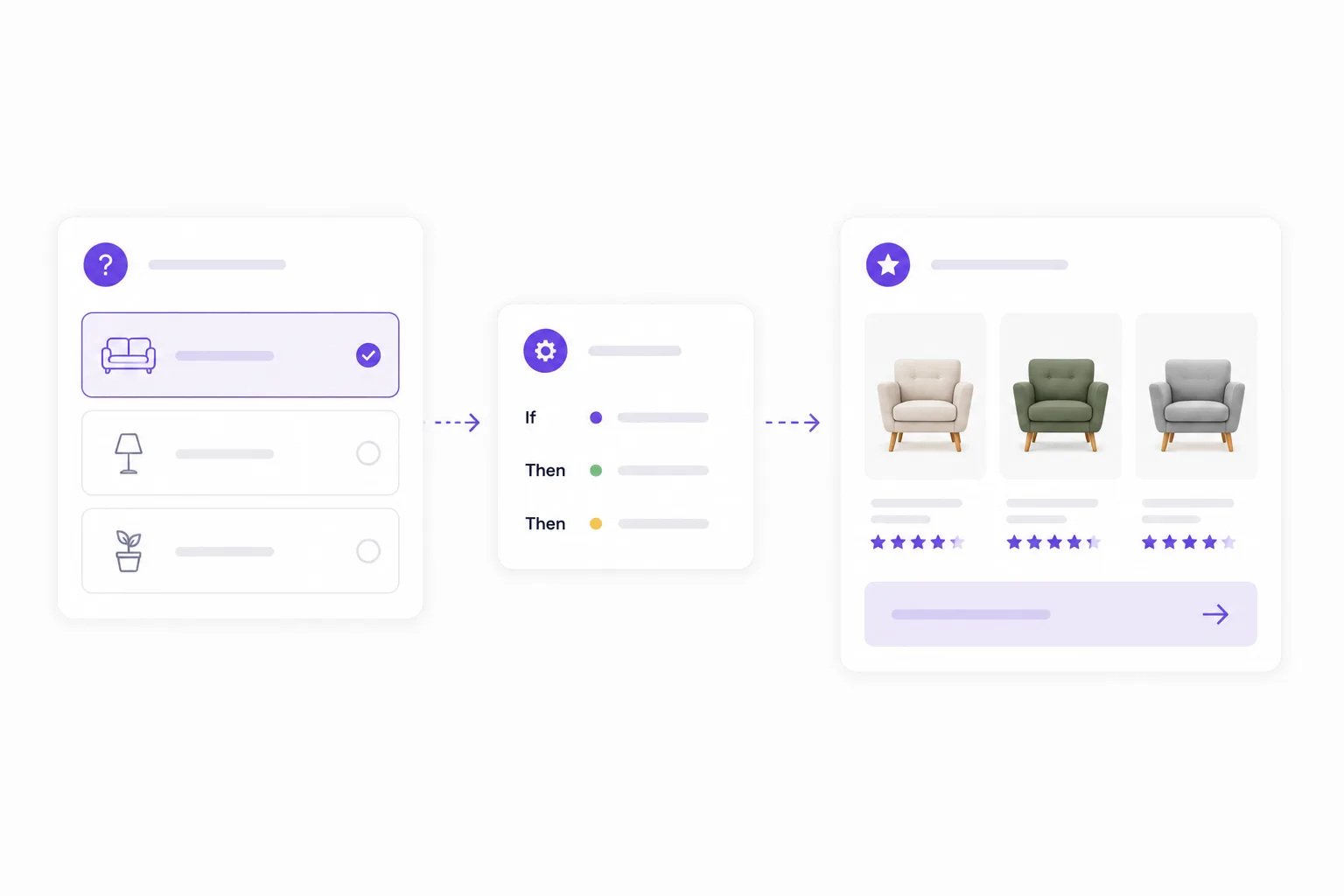
A product advisor is the recommendation layer. It turns the answers into one best match, a shortlist, a bundle or a clear explanation of what fits.

Comparison: marketing quiz, product quiz and product advisor
| Format | Main goal | Best for | Output |
|---|---|---|---|
| Marketing quiz | Attention, leads, segmentation | Campaigns, social, email growth | Profile, score or signup |
| Product quiz | Faster product discovery | Simple categories or preference-led choices | Product, category or routine |
| Choice helper / advice flow | Buying decision support | Complex catalogs, variants, fit questions | Explained recommendation |
| Product advisor | Recommendation after the flow | Category pages, product pages, widgets | Best match with context |
These formats can overlap. A strong product quiz can also work as a product advisor. The key question is depth. Are you mainly asking about taste and preference? Then it is probably a product quiz. Are you checking suitability, compatibility, use case or exclusions? Then you need a more serious product advisor.
When a product quiz is enough
A product quiz works well when shoppers need inspiration more than strict guidance. The decision is not too risky, the answers are easy to understand and the recommendation can be based on a few clear preferences.
Examples:
- A fragrance quiz that maps shoppers to scent families.
- A coffee quiz based on intensity, milk drinks and budget.
- A skincare routine quiz based on skin type and texture preference.
- A gift quiz based on age, price range and occasion.
The job of the quiz is speed and recognition. The shopper should feel: "This sounds like me." It does not need to handle every edge case. It needs to be clear, pleasant and useful enough to narrow the catalog.
Still, a product quiz needs decent product data. If every path leads to the same bestsellers, shoppers will notice.
When you need a product advisor
A product advisor is stronger when shoppers can genuinely get stuck. That often happens in categories with specifications, sizes, compatibility, use cases or "fits / does not fit" criteria.
Examples:
- A supplement store that considers goals, diet preferences and usage moments.
- A pet store that recommends food based on animal, age, sensitivities and preference.
- A tools store where material, job type and experience level matter.
- A B2B store where parts must fit a machine, model or application.
- A home and garden store where space, light, care level and style all affect the choice.
In these situations, a fun quiz is not enough. Shoppers want confidence. Why does this product fit? Why are other products less suitable? What should they choose when several options look similar?
A choice helper or advice flow solves that by combining questions, branching logic, product matching and explanation. The shopper sees a simple experience, while the underlying logic does the harder work.
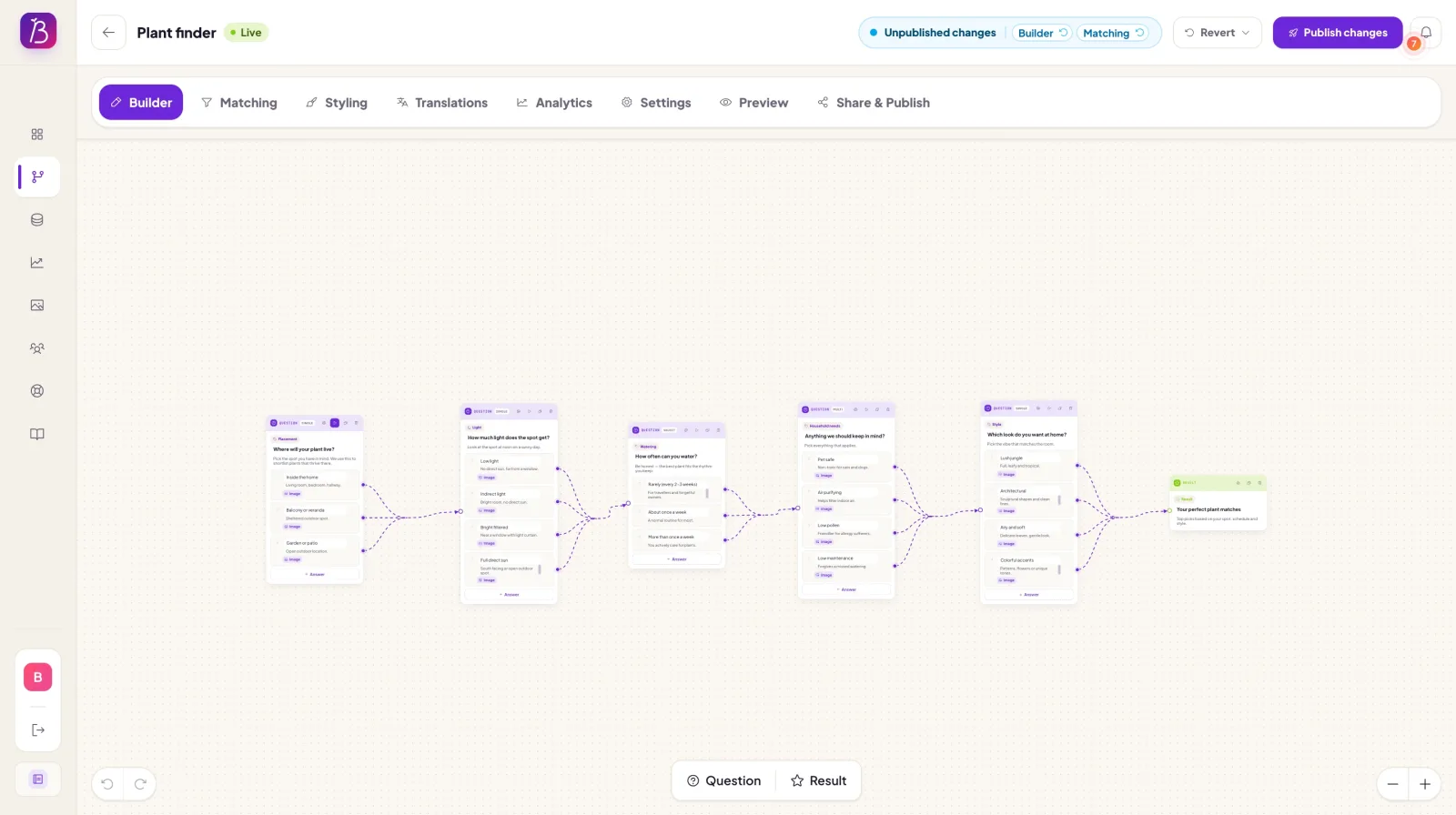
What makes product advice useful?
Product advice is not just a row of recommended products. It is a recommendation with context.
Good product advice usually includes:
- one best match or a small shortlist;
- a short reason why the product fits;
- alternatives for budget, taste or use case;
- a clear next step to the product page or cart;
- honest logic that does not always push the most expensive item.
That last point is important. Shoppers can feel when advice is only a sales push. A credible product advisor can recommend a simpler product when that is the better fit.
Practical ecommerce example
Imagine you sell running shoes.
A marketing quiz asks: "What type of runner are you?" The result might be a lifestyle profile and an email signup.
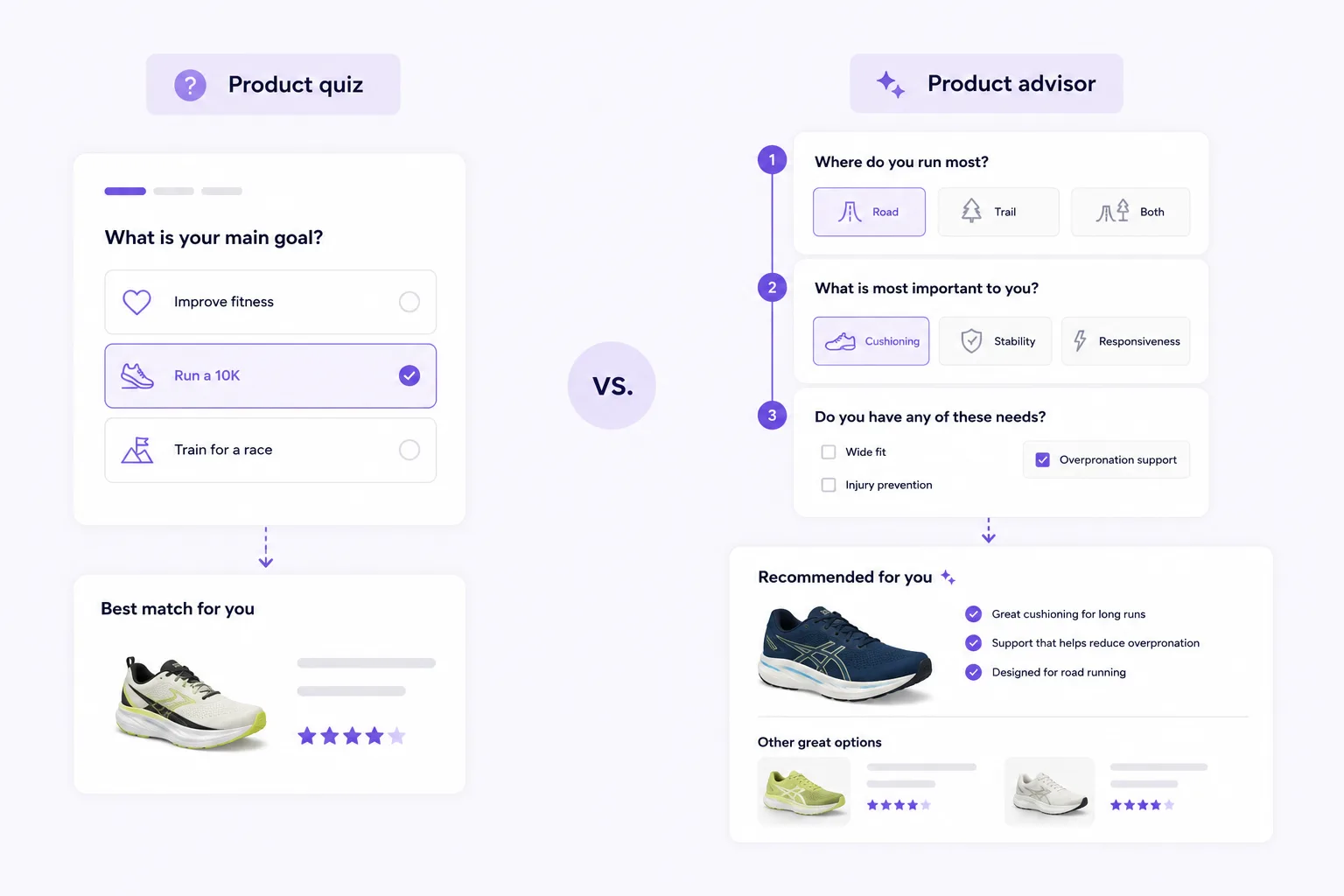
A product quiz asks: "Do you run short or long distances? Road or trail? Do you prefer soft cushioning?" It then shows a few relevant models.
A product advisor goes further. It asks about experience, injury sensitivity, surface, fit, running goal and stability needs. Products that do not fit are removed. Strong matches get a higher score. The result explains why shoe A is a better fit than shoe B.
The difference is not that the product advisor must be long. The difference is that every question changes the recommendation.
How to choose the right format
Start with the shopper's hesitation.
If the shopper mainly wants inspiration, use a product quiz. Keep it short, clear and easy to complete. Place it on landing pages, category pages or campaign pages.
If the shopper is afraid of making the wrong choice, build a choice helper or product advisor. Use practical questions, show relevant options and explain the outcome. Place the Flow widget where hesitation happens: category pages, product detail pages or advice pages.
If your main goal is lead generation, use a marketing quiz and be honest about it. That can work well, as long as you do not present it as deep product advice when the logic is not there.
Common mistakes
The biggest mistake is starting with product attributes instead of shopper questions. A shopper does not think in feed fields. They think in situations: "I have sensitive skin," "I need low maintenance," "I do not know which size fits," or "I want the safest option."
Other common mistakes:
- asking too many questions before giving value;
- using answers that do not change the result;
- recommending only bestsellers;
- showing products without explaining the match;
- using one generic flow everywhere, even when the hesitation differs by page.
A good advisor feels calm. It asks exactly enough to make the recommendation better.
FAQ
Is a product quiz the same as a product advisor?
Not always. A product quiz is often shorter and more preference-led. A product advisor supports a buying decision and usually uses stronger product data, rules and explanations.
Which one is better for conversion?
It depends on the category. A simple product quiz can work well for inspiration-led products. A product advisor is usually stronger when shoppers compare complex products, variants or fit-based options.
Where should I place a product advisor?
Place it where shoppers hesitate: category pages, advice pages, product detail pages or campaign pages around a specific decision.
How long should a product quiz be?
As short as possible, but not shorter than useful. Five meaningful questions are better than three vague ones. Every question should influence the recommendation.
Start with one decision
Want to help shoppers choose instead of leaving them to compare everything alone? Build an advice flow that connects questions, product data and product recommendations. Start with one category, place the Flow widget in your store and improve the advice step by step.
If you want to turn that flow into a product selector, start with product finder software, then connect the key matching fields in product data.