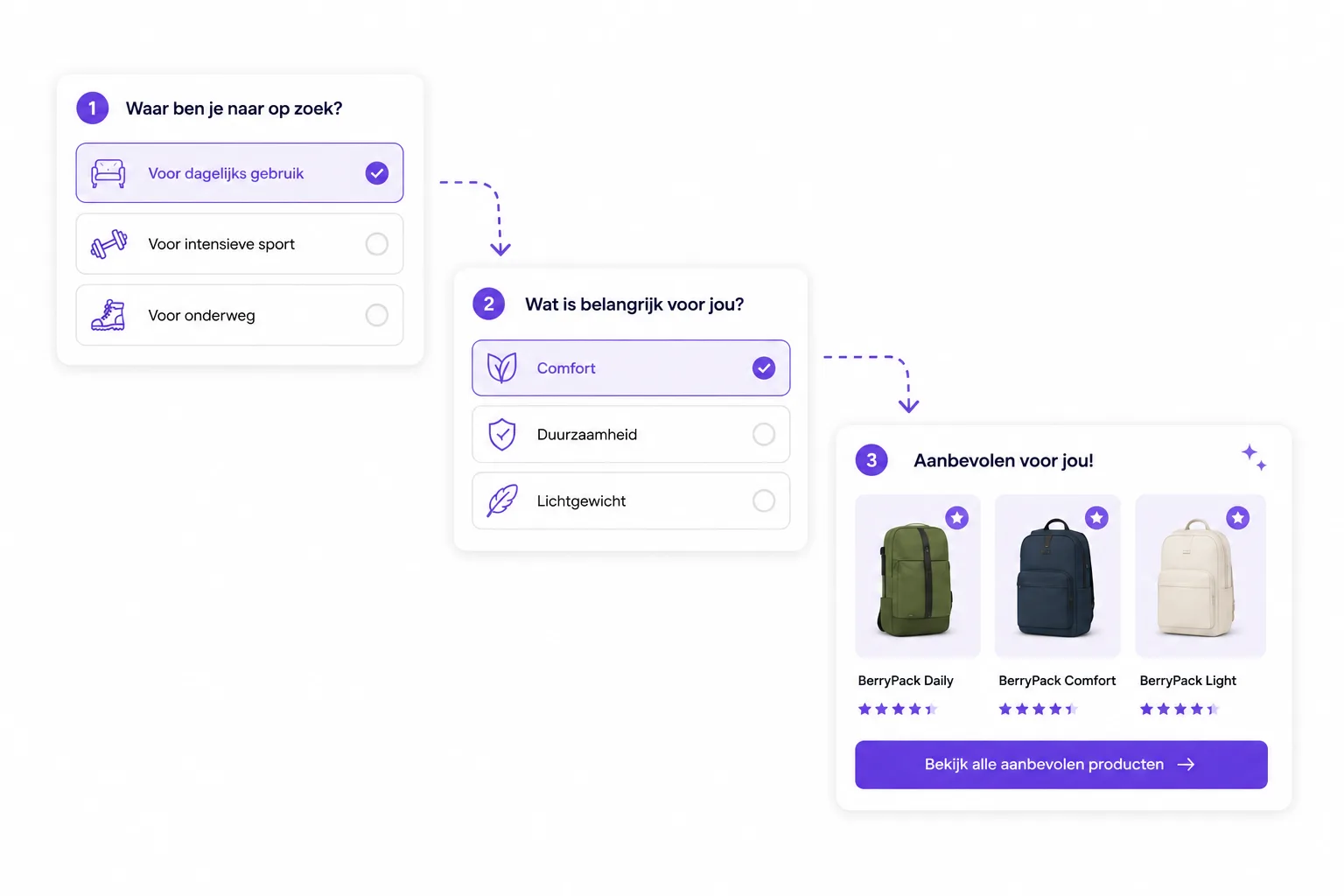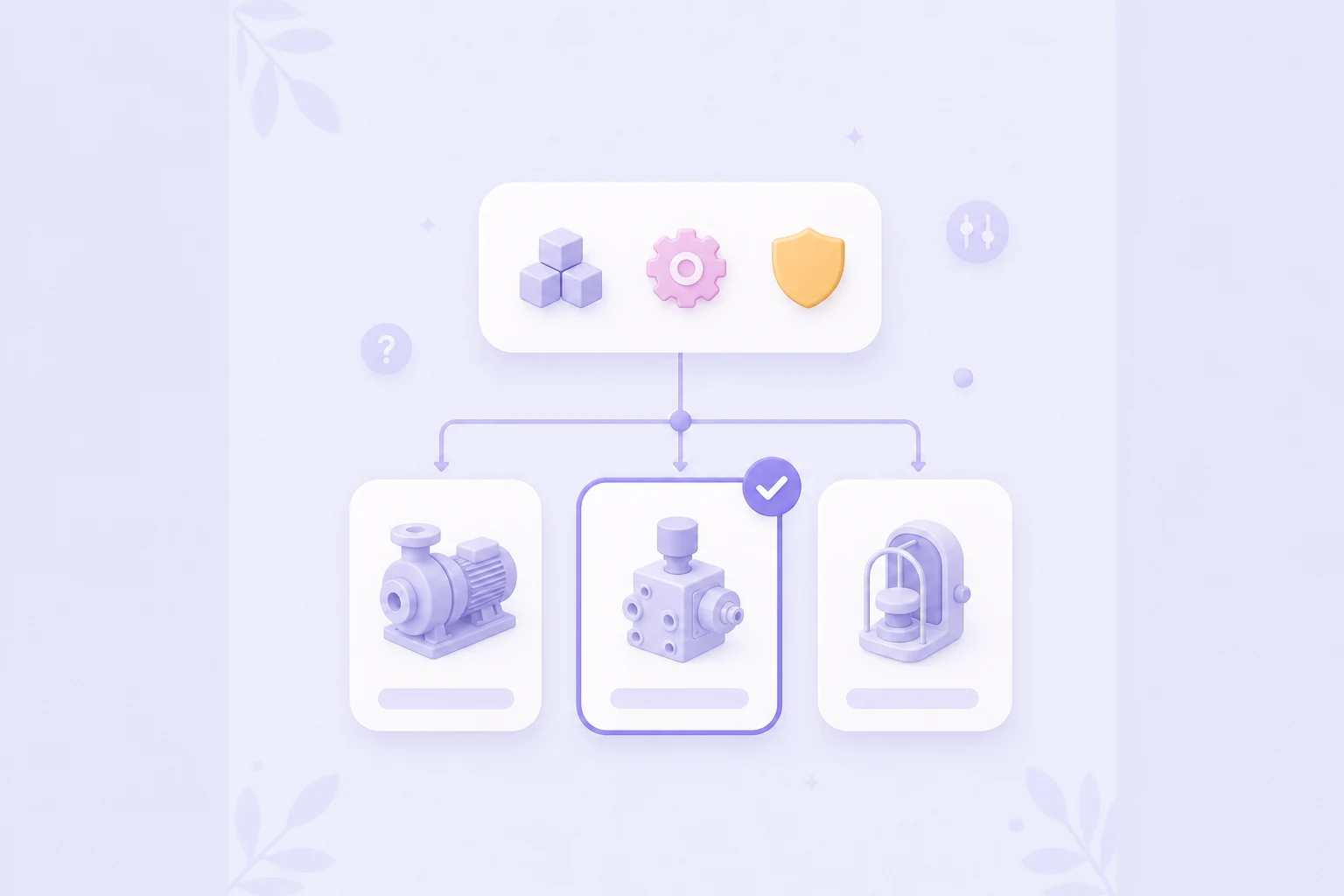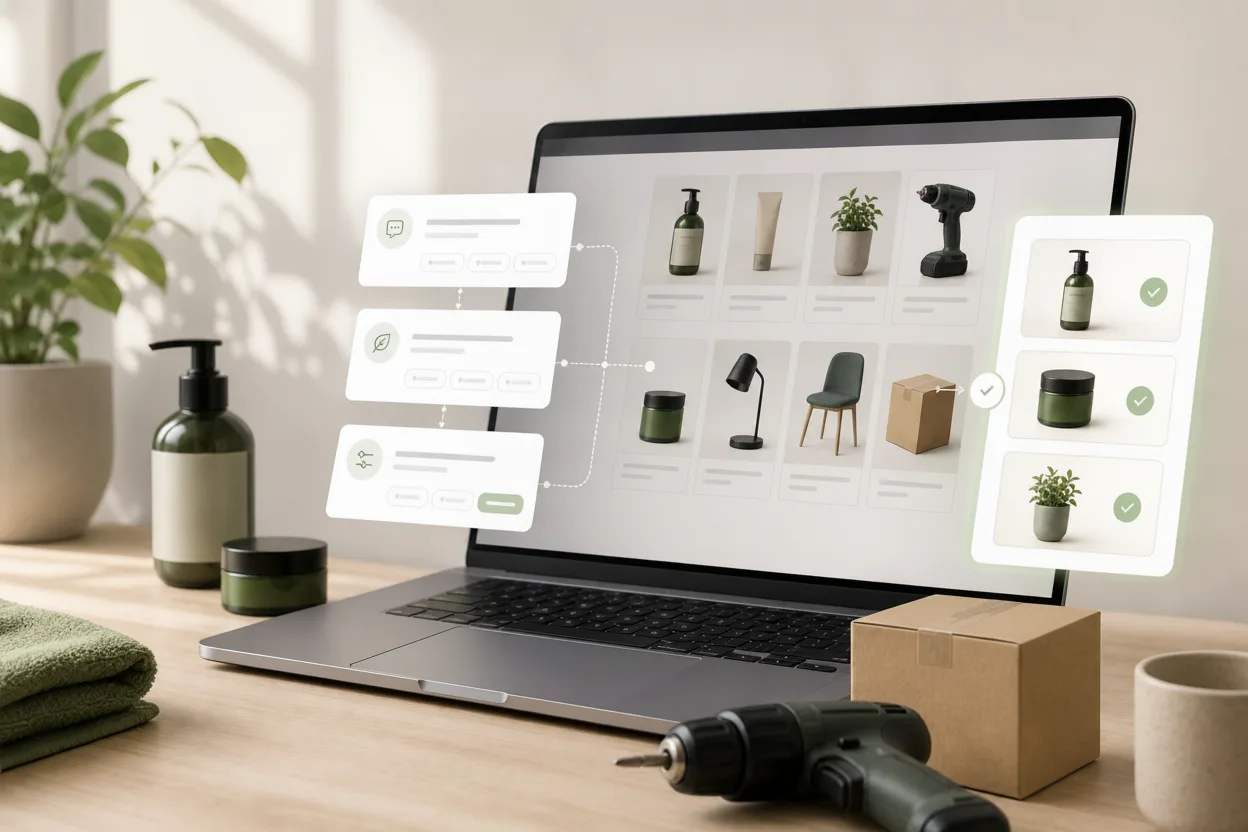

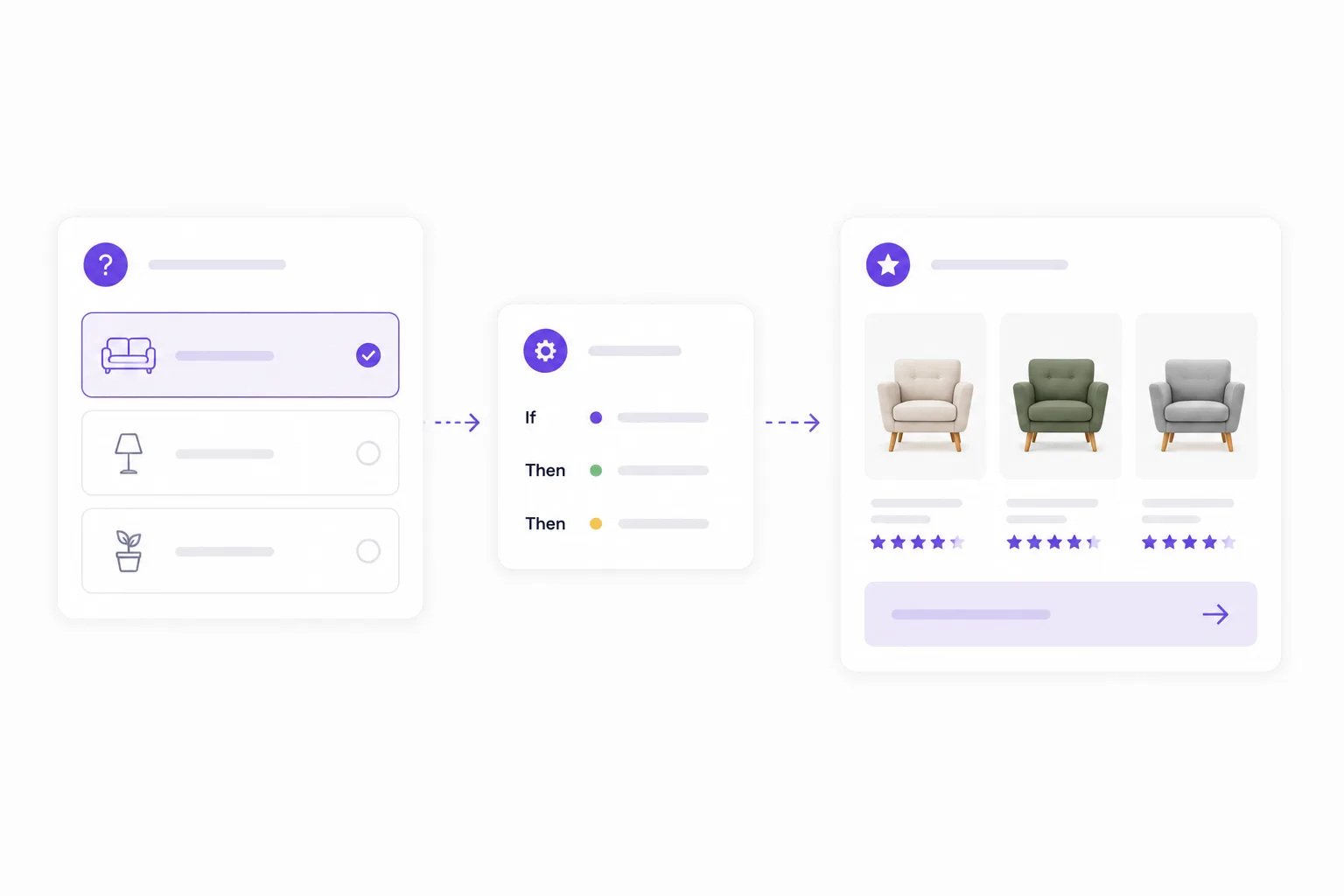
A product advisor helps webshop visitors choose the right product when the catalog feels too large, too technical or too similar. Instead of asking shoppers to compare every filter, specification and product page by themselves, you ask a few focused questions and turn the answers into clear product advice.
This is especially useful when shoppers know what they want to achieve, but not which product fits. Think of skincare, supplements, tools, pet food, plants, sports gear, spare parts, electronics or B2B products with many variants.
A good product advisor should not feel like a random quiz. It should feel like help at the right moment: short, practical and connected to the shopper's situation.
Why product advisors work in ecommerce
Many visitors are not ready to buy when they land on a category or product page. They are comparing options, checking whether a product fits, or trying to avoid a bad purchase.
Filters are useful when shoppers already know which specifications matter. A product advisor helps before that point. It translates your product knowledge into simple questions about use case, preference, problem, budget or context.
That can improve the buying journey in several ways:
- Less choice stress: shoppers see fewer irrelevant options.
- More confidence: the advice is based on their answers.
- Better product clicks: visitors reach product pages with more context.
- Less support pressure: recurring advice questions are answered inside the webshop.
- Useful insight: you learn which needs and doubts appear most often.
The goal is not to push every visitor to the most expensive item. Strong product advice recommends what fits. Sometimes that is a simpler product, an alternative or a bundle.
Start with the shopper's decision
Do not start with the full product catalog. Start with the decision your shopper is trying to make.
Ask yourself: what is the real question behind the visit?
- Which cleaner is safe for this material?
- Which supplements fit my goal?
- Which size or variant do I need?
- Is this product suitable for my situation?
- Which starter set should I choose?
That decision becomes the foundation of the advice flow. Every step should help shape the recommendation. If a question does not change the advice, it probably does not belong in the first version.
Good questions use customer language
A strong product advisor uses words shoppers already understand. Avoid internal product terms when they need extra explanation.
Instead of: "Which application method do you prefer?"
Ask: "How do you want to use the product?"
Instead of: "Choose the compatibility class."
Ask: "What should the product fit?"
The closer your questions are to customer language, the less explanation the flow needs.
Turn answers into product advice
After the questions comes the logic. An answer can do several things:
- exclude products that do not fit;
- increase the score of products that match;
- show a follow-up question;
- start a different route;
- or recommend a bundle or accessory.
To do that well, you need useful product data. It does not have to be perfect from day one. Start with the attributes that actually matter for the advisor: use case, material, size, audience, compatibility, price level, style, maintenance or problem type.
The result should stay explainable. Shoppers do not only want a product list. They want to understand why a product is recommended. One short sentence can be enough: "This fits your answers because it is suitable for daily use and needs little maintenance."

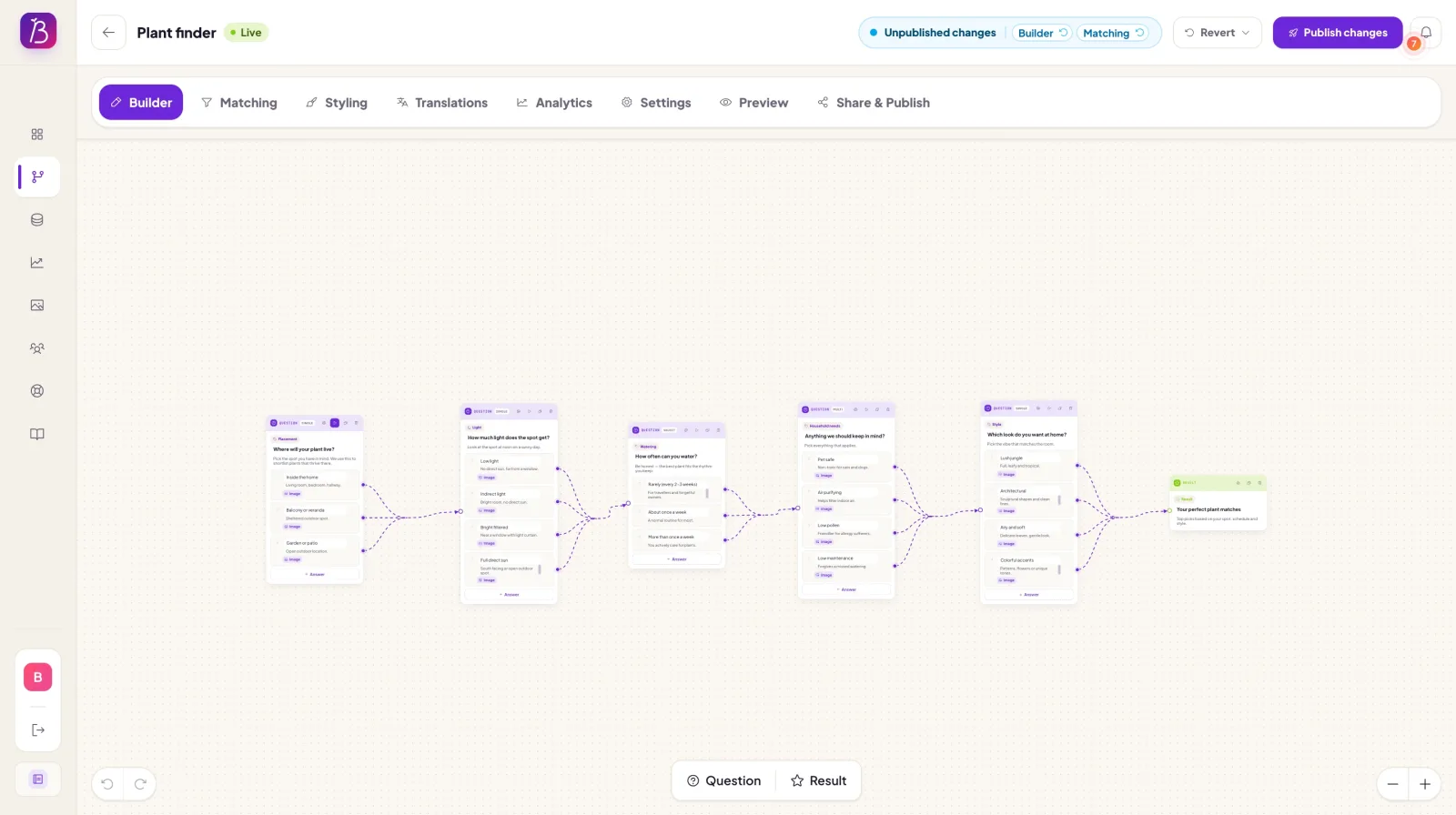
Build a short advice flow
Your first product advisor does not need to cover every possible scenario. Start with one category or one common buying question.
A practical first version includes:
- One clear opening question.
- Three to six questions that influence the recommendation.
- Product matching based on a limited set of attributes.
- A result screen with a best match, alternatives and explanation.
- A clear next step to the product page or cart.
Shorter is usually better. Every extra question has to earn its place. If shoppers leave before seeing the result, the flow may be too long, too vague or too technical too early.
Make the result useful
The result screen is not just a list of products. It is where you build trust.
Show:
- the best match;
- one or two useful alternatives;
- a short explanation for each recommendation;
- relevant differences between the options;
- and a clear button to continue.
If a product is not a perfect fit, be honest. Credible advice is stronger than advice that only tries to sell.
Add the Flow widget where shoppers hesitate
A product advisor works best where visitors need help moving forward.
Category pages are often the natural starting point. When a category contains many similar products, the Flow widget can narrow the catalog quickly.
Product pages can be just as valuable. Many shoppers arrive directly from search, ads or email. Their question is often: "Is this right for me?" A short product check can confirm the choice or point to a better match.
Landing pages and campaigns work well when the advisor is tied to one need, season or product group. Examples include "find your starter set", "choose your winter routine" or "check which part fits".
Do not only place the Flow widget where the catalog starts. Place it where shoppers get stuck.

Product data does not need to be perfect first
Many ecommerce teams postpone product advice because their product data is not fully clean yet. That does not have to block you.
Start with a small product set and a few reliable attributes. You can expand later. In many cases, you only learn what is missing after people start using the advisor.
A useful approach:
- choose one product category;
- decide which attributes truly affect the advice;
- enrich only those attributes first;
- manually test the recommendations;
- publish a small version and improve it.
This keeps product data manageable. It becomes part of a practical improvement cycle instead of a huge project before launch.
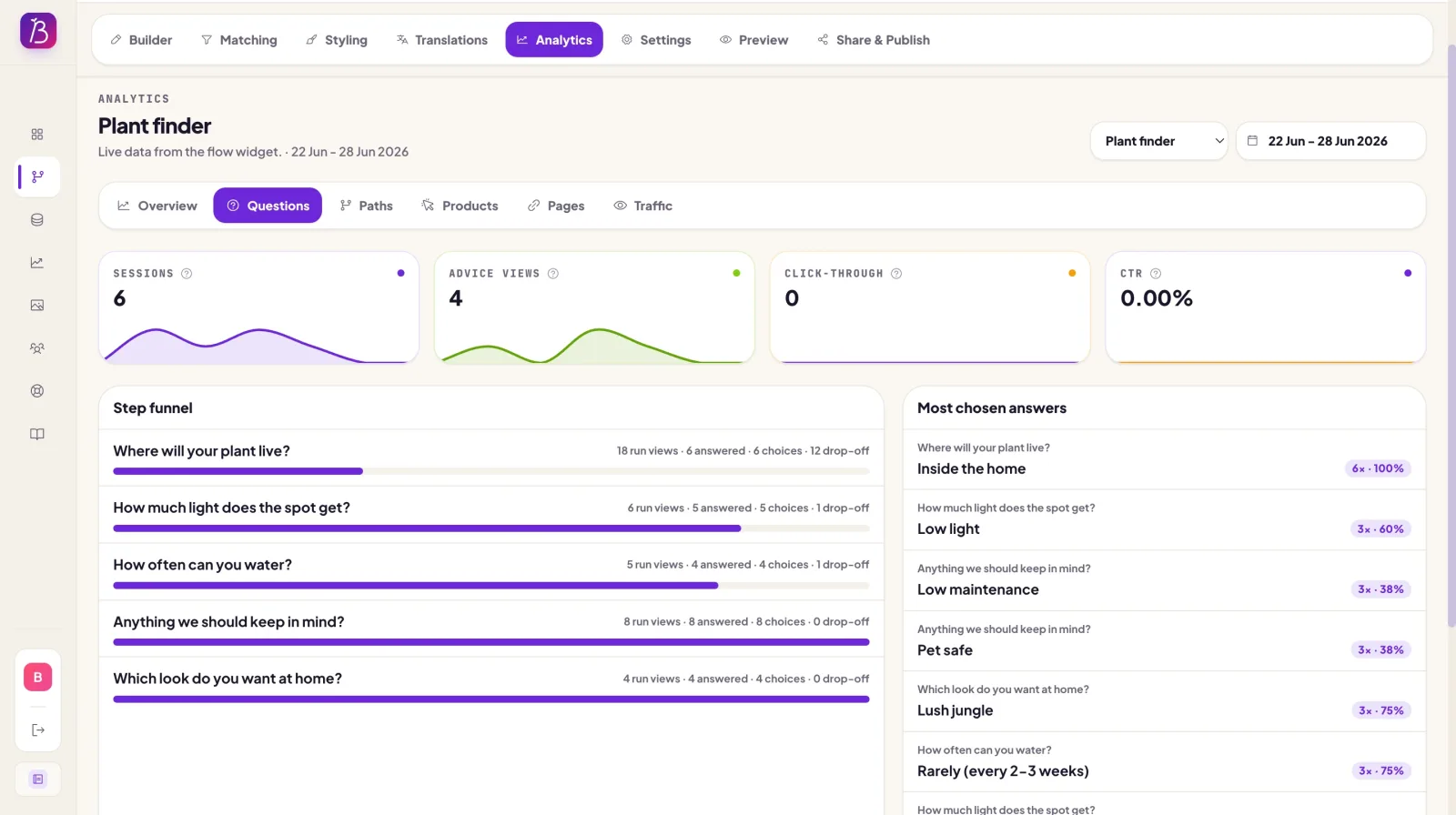
Measure where shoppers drop off
After publishing, the real learning starts. Do not only look at conversion. Look at behavior inside the advice flow.
Useful questions include:
- Where do visitors start the product advisor?
- At which question do they leave?
- Which answers appear most often?
- Which products are recommended most often?
- Do visitors click through to product pages?
- Are there recommendations that your sales or support team would question?
Use those insights to make the flow shorter, clearer and more accurate. Sometimes you only need to add one missing answer option. Sometimes a question should move earlier. Sometimes the product data needs cleanup.
A product advisor gets better through use.
Common mistakes
The most common mistake is starting too broad. A product advisor for your entire catalog sounds attractive, but it is often too much for a first version. Start with one clear shopper question.
Other common mistakes:
- asking too many questions;
- using internal product language;
- giving recommendations without explanation;
- always steering to the most expensive product;
- hiding the Flow widget on a low-traffic page;
- relying on product data that is not trustworthy;
- publishing once and never improving the flow.
Good product advice stays practical. It helps the shopper make a better decision today.
Product advisor FAQ
How many questions should a product advisor have?
For a first version, three to six questions are often enough. Only ask questions that change the recommendation. If you need more detail, split the advisor into clear routes instead of building one long flow.
Is a product advisor the same as a product finder?
A product finder is one type of product advisor. A product advisor is broader: it includes questions, product data, matching logic, recommendation explanations, placement in the webshop and improvement over time.
Where should I place a product advisor in my webshop?
Start where shoppers hesitate most: category pages with many similar products, product pages with fit questions, advice pages and campaign pages. Then measure where the Flow widget is used most.
Can I build a product advisor without perfect product data?
Yes. Start with one category and the product attributes you truly need for product advice. Expand step by step based on shopper behavior, support questions and sales insight.
Build your first product advisor with BerryPath
With BerryPath, you can build an advice flow, connect product data and publish the Flow widget in your webshop. Start small: choose one category, ask the most important questions and give shoppers product advice they can understand right away.
Try the demo, read how to build an advice flow, or explore more about what a webshop choice helper is, product finder software, a product advice tool and the Flow widget.
How to build the first product advisor
Start narrow, publish quickly and improve from real shopper behavior.
- 1 Pick one product group Choose a category where shoppers compare too long or ask support for advice.
- 2 Write the important questions Use the questions a store expert or support team already asks.
- 3 Connect product data Map the product fields that should influence recommendations.
- 4 Set matching rules Decide which answers filter products and which answers only boost a better fit.
- 5 Publish and measure Place the Flow widget, track usage and improve questions from drop-off data.