
Launching a product advisor is a good first step. It is not the finish line.
The first version usually reflects what your team already knows: common customer questions, important product differences and the advice you would give in store. The next version should be shaped by real visitors. Where do they start? Where do they stop? Which answers lead to a product click? Which recommendations are ignored?
If you are still choosing the setup, start with product advisor software that lets your team edit questions, matching and results without turning every improvement into a development project.
That is where a product advisor becomes more than a nice interface. It becomes a feedback loop for your category, content and merchandising work.
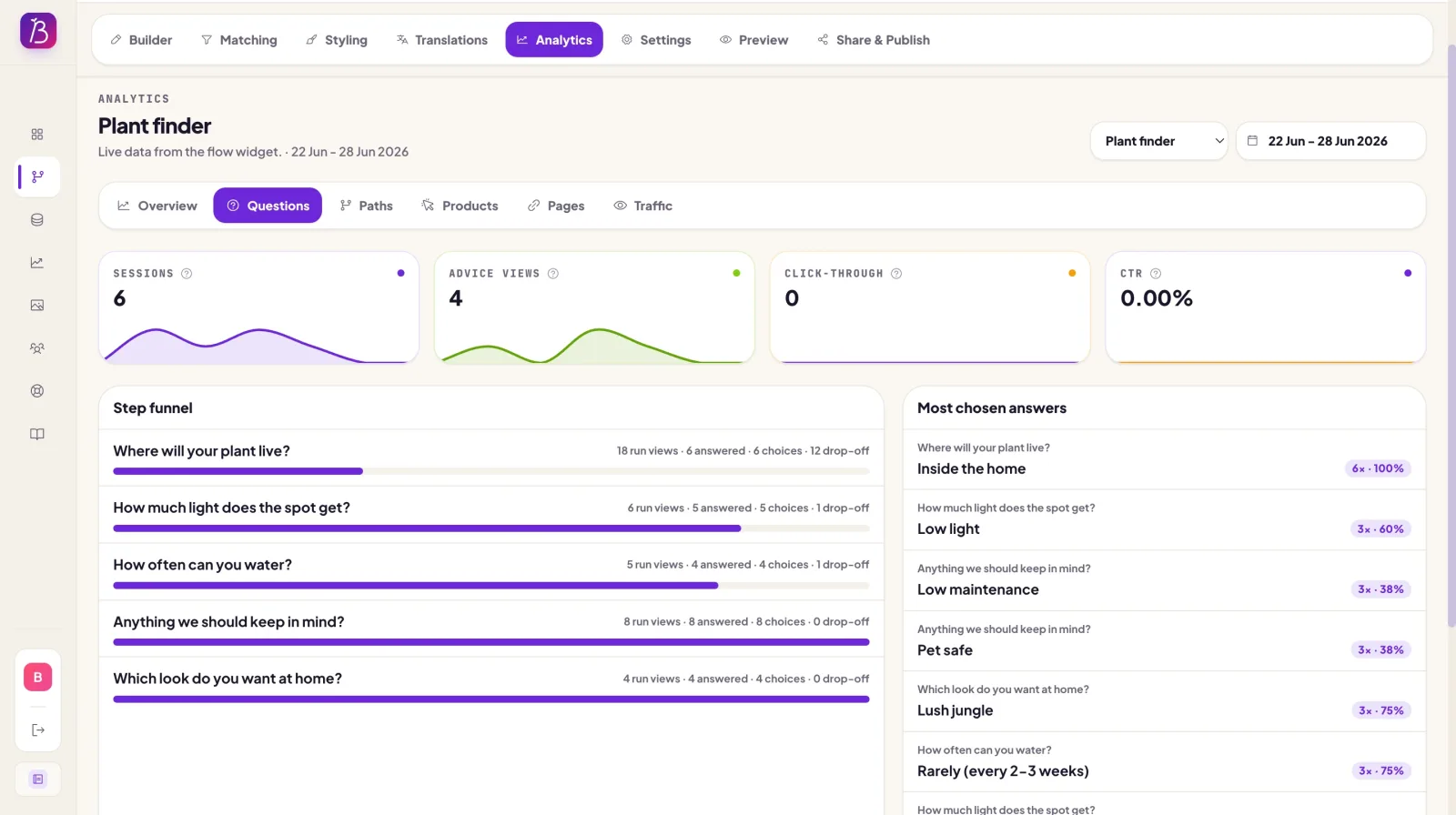
Start with the completion rate
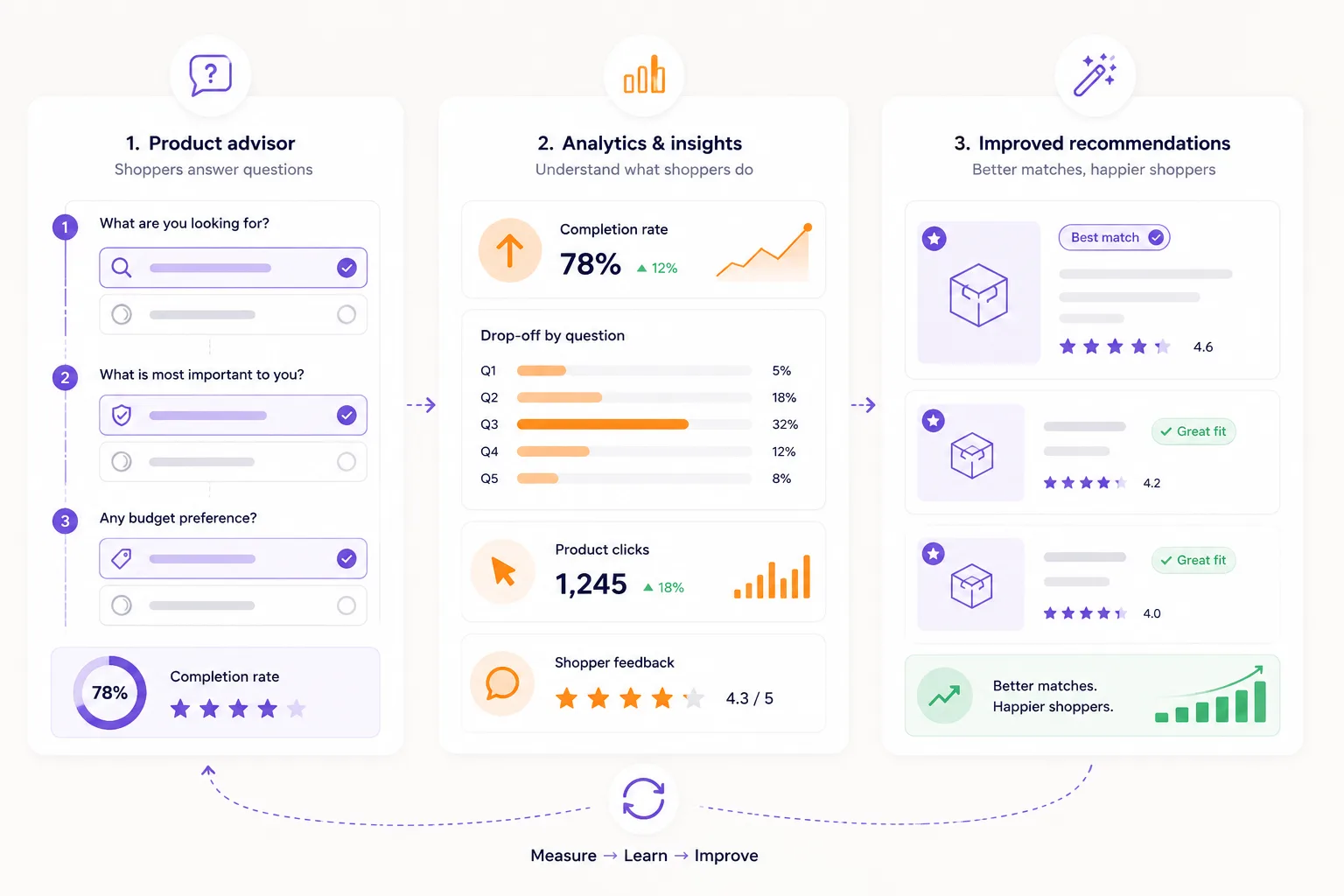
The first number to watch is simple: how many visitors who start the flow also reach a recommendation?
If many visitors drop off, do not immediately blame the product data. Often the problem is one of these:
- the entry point promises something the flow does not deliver;
- the first question is too broad or too technical;
- a question asks for information the visitor does not know yet;
- the flow feels too long for the decision;
- answers overlap, so visitors are unsure which one to choose.
Look at drop-off per question. If one question loses a lot of people, rewrite it in plain language. Add examples. Replace internal specifications with shopper-friendly situations. If a question does not change the advice, remove it.
Check recommendation quality
Completion only matters if the result feels useful. Review the recommendations like a customer would.
Ask these questions:
- Does the top result clearly fit the answers?
- Is the reason for the match understandable?
- Are alternatives genuinely useful, or just filler?
- Does the flow avoid dead ends when an exact match is not available?
- Are out-of-stock or unavailable products handled calmly?
Good advice does not need to be perfect in a mathematical sense. It needs to be credible. A shopper should understand why a product is shown and what trade-off they are making.
Measure product clicks
A product advisor should not only generate a result. It should help the visitor take the next step.
Track click-through from the recommendation to the product page. A low click-through rate can mean the recommendation is wrong, but it can also mean the result card is unclear.
Improve the result view before rebuilding the whole flow:
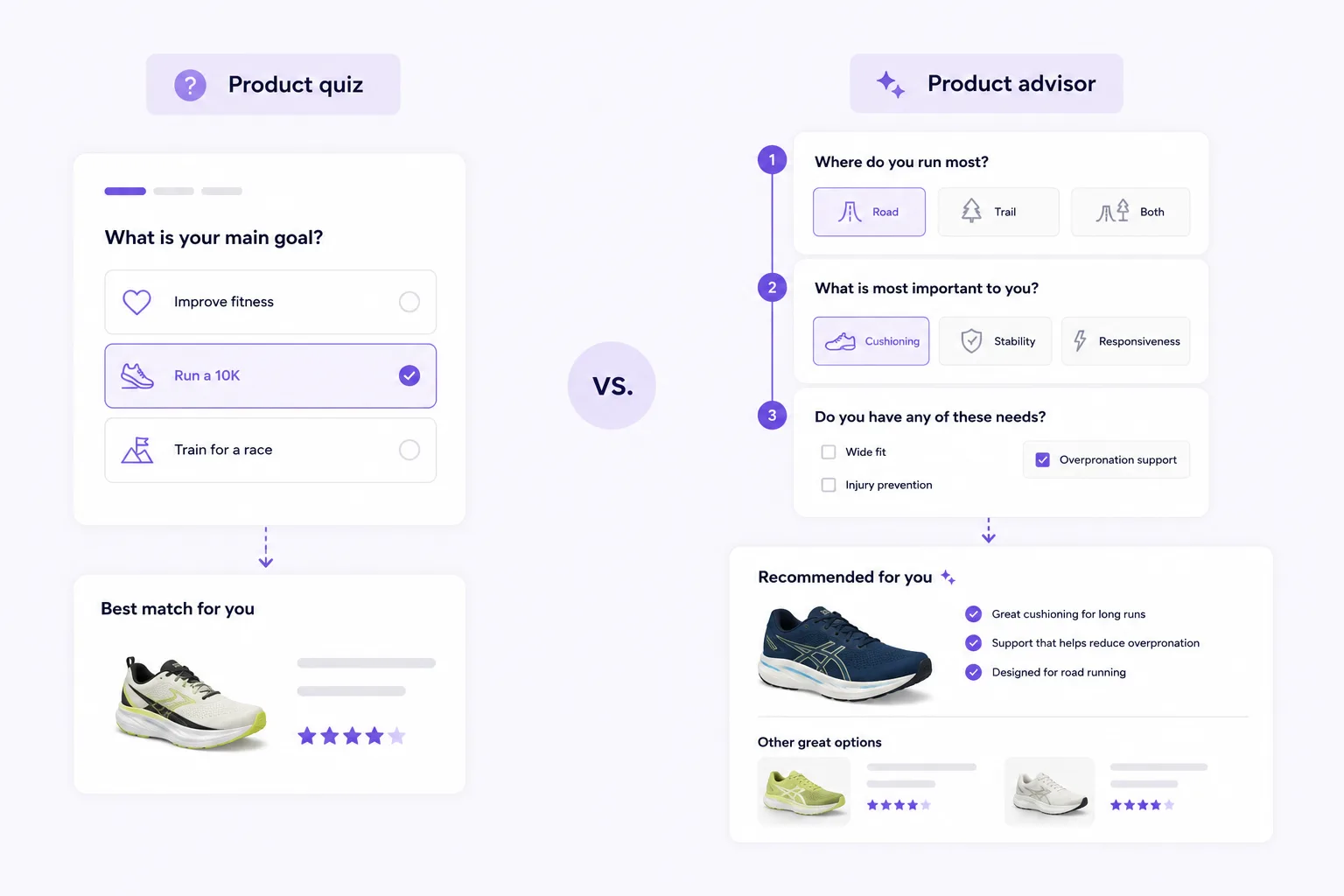
- make the product name and image easy to scan;
- show one or two match reasons;
- avoid generic labels such as "recommended";
- add a clear product-page button;
- keep secondary products visible without making the result feel crowded.
If visitors complete the flow but do not click, the answer is often in the result presentation.
Compare answers with support questions
Your product advisor should reduce repetitive advice questions over time. Compare flow answers with support tickets, live chat questions, search terms and return reasons.
If many shoppers ask support the same question after using the advisor, add that concern earlier in the flow or in the recommendation explanation. If visitors search for a product attribute that is missing from your matching data, add it to the product feed.
This keeps the flow grounded in real customer language instead of internal category structure.
Improve product data gradually
You do not need perfect product data before launching. You do need enough data to make trustworthy recommendations.
Start with the attributes that actually change advice:
- use case;
- compatibility;
- size or capacity;
- material;
- budget range;
- experience level;
- care level;
- restrictions or warnings.
Then improve the weak spots. If too many products tie for the same score, add a more specific attribute. If too few products match, review strict rules and replace some of them with scoring or boosts.

Use placement as an optimization lever
Sometimes the flow is good, but hardly anyone sees it.
Test entry points on:
- category pages with many similar products;
- product pages where visitors need validation;
- landing pages for seasonal or campaign traffic;
- support pages with recurring buying questions;
- email or social campaigns that send people into a specific advice route.
Do not judge a product advisor only by one placement. A category finder, product-page check and campaign guide can use the same logic but solve different moments of doubt.
Keep a monthly improvement rhythm
Optimization works best when it is routine. Once a month, review:
- starts and completion rate;
- drop-off per question;
- top answers;
- products recommended most often;
- product clicks;
- support questions related to the category;
- products with weak or missing matching data.
Pick one improvement. Publish it. Then measure again.
That rhythm is more useful than rebuilding the flow every quarter. Small improvements, based on real behavior, keep the advice fresh and trustworthy.
A good product advisor keeps learning
The best product advisors do not try to impress visitors with complexity. They help shoppers move from doubt to a clear next step.
Launch a focused version. Watch where people hesitate. Improve the questions, matching and result explanations. Then keep repeating that process.
That is how guided selling turns from a one-time project into a practical growth tool for your webshop.
How to improve a product advisor after launch
Use behavior data to make the flow shorter, clearer and more useful.
- 1 Review drop-off Find the questions where visitors stop and simplify the wording or route.
- 2 Check recommendation quality Look for answers that return weak or empty results and adjust matching.
- 3 Compare product clicks See which recommendations shoppers trust enough to open.
- 4 Use support feedback Add missing doubts or common questions that still reach your team.
- 5 Repeat monthly Small, regular improvements usually beat one large rebuild.