
The best guided selling software depends on your catalog, advice format and team. Compare how each tool handles product data, requirements, preferences, placement and measurement. Shortlist two or three tools, then test the same category and answer paths. Published customer results provide context, not a forecast for your webshop.
Guided selling for webshops or CPQ?
This comparison covers shopper-facing product advice. Visitors describe their needs and receive product recommendations. CPQ is a different workflow for configuring, pricing and quoting deals. A B2B webshop may need either or both; define that boundary before choosing software.
Compare B2B product advice and CPQ.
How to compare the tools
Use the same six questions for every supplier. The list below is a shortlist, not an independently scored ranking. The order does not indicate that one vendor is universally better.
- Fit: does the advice format solve your shoppers' actual choice problem?
- Control: who maintains questions, rules and product knowledge after launch?
- Data: how are missing attributes, compatibility requirements and preferences handled?
- Cost: what is included for your categories, languages, traffic and support needs?
- Placement: can you test the experience on your actual storefront and mobile devices?
- Evidence: can you inspect a comparable implementation and understand its measurement?
BerryPath publishes this guide and is included in it. Product descriptions are based on the linked public supplier pages reviewed on 23 September 2026 and our own product knowledge. We have not run an independent trial of every tool. Details we could not confirm are marked for verification, not treated as missing features.
Eight guided selling tools to consider
BerryPath: self-service advice flows
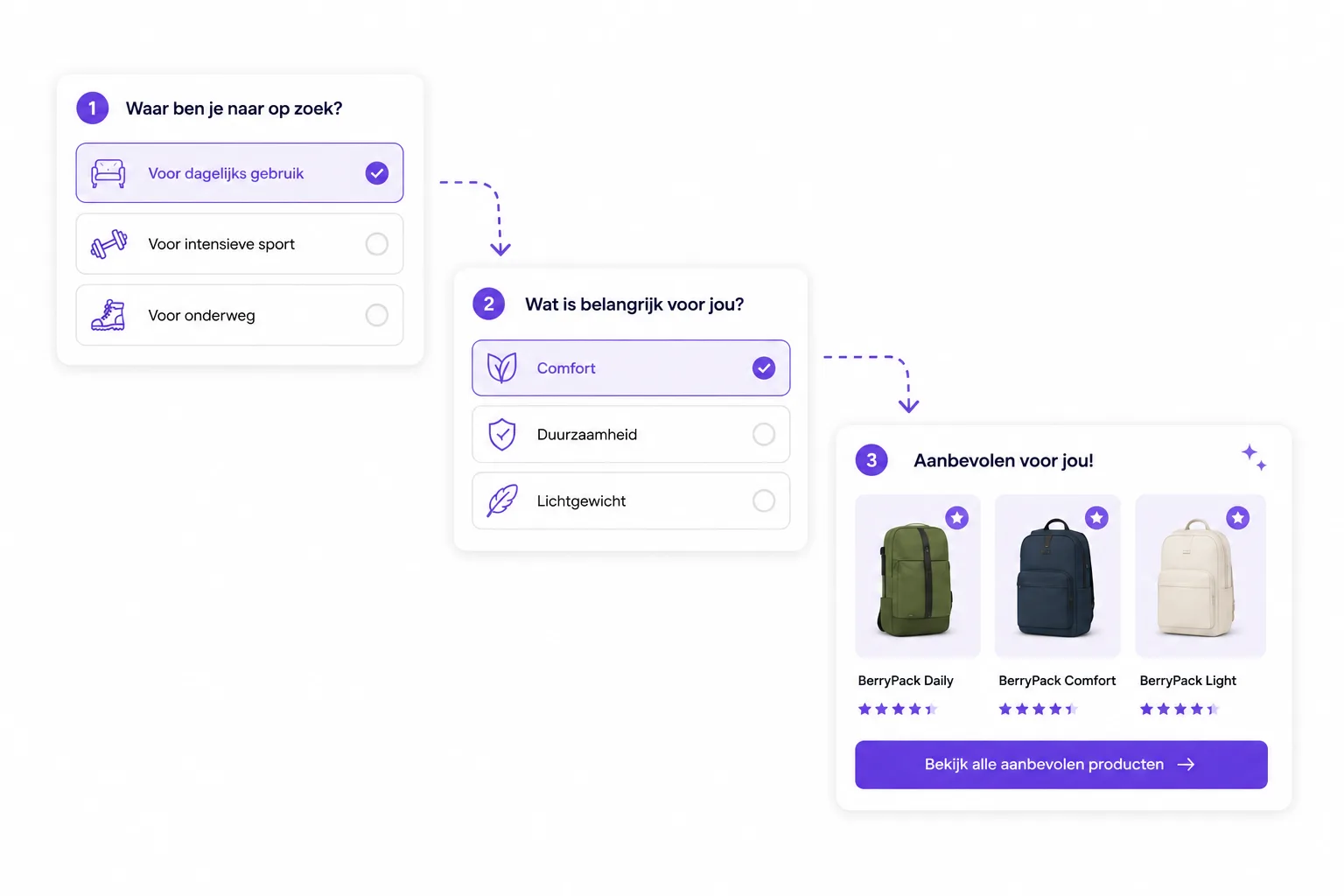
Build questions visually, connect your product feed or upload, and use matching rules to distinguish requirements from preferences. Publish the Flow widget in your shop, adjust its styling and review advice usage. Start with one category and check the current plan limits and included features before expanding.
What to verify Check: whether your product attributes support the advice you want, which plan covers your needs, and who will maintain the flow. AI and removal of provider branding depend on the selected plan.
View current plans and limits.

Aiden: scripted and AI-led product advice
Aiden presents scripted, conversational and agentic advice modes. That makes it relevant to teams evaluating how much of the conversation to control themselves and how much to delegate to AI. Its public site includes retailer implementations and advice-performance examples.
What to verify Ask which advice mode, onboarding, catalog work and reporting are included in a proposal for your storefront.
Supplier product information: Aiden.
Qonfi: product finders, bundles and configurations
Qonfi presents structured and agentic advice, product finders, bundles, configurators and lead-generation use cases. Its public pages include customer stories and a trial offer. It is a relevant option when advice involves more than recommending one product.
What to verify Confirm the current package, included advice formats, language coverage, integration work and total cost with your own use case.
Supplier product information: Qonfi.
Zoovu: multichannel product discovery
Zoovu presents product discovery across brands, retailers and sales channels. Include it when your project involves distributing product expertise and advice across more than one storefront or market.
What to verify Ask for a demonstration with your catalog, required channels, data ownership and implementation responsibilities.
Supplier product information: Zoovu.
Crobox: product finders and product insights
Crobox combines question-and-answer product finders with product-data enrichment and analytics. Its product page describes filtering and ranking rules, A/B testing and placement across category, product and campaign pages.
What to verify Check how much setup is self-service, where professional services are needed and how experiments and reporting are priced.
Supplier product information: Crobox.
Neocom: commerce experience platform
Neocom presents itself as an AI-native commerce experience platform. We could not reliably verify the detailed feature set from its current public page in this review, so we do not assign no-code, pricing or performance scores.
What to verify Request a current product demonstration, implementation scope, package details and a comparable customer reference.
Supplier product information: Neocom.
Excentos: product selectors
Excentos offers product selectors for B2B and B2C catalogs. Its public product page describes a no-code Workbench and links to editions and customer examples.
What to verify Test your specification and compatibility rules, then confirm the edition, data preparation and support needed for your catalog.
Supplier product information: Excentos.
Outfindo: product guidance and data enrichment
Outfindo combines consumer research, product-data enrichment and product guides. Its proposition includes translating customer needs into decision parameters and enriching the product information used by the guide.
What to verify Ask which categories are covered, how attributes are sourced and kept current, and who can adjust questions and recommendations.
Supplier product information: Outfindo.
A practical shortlist
| Tool | Focus to evaluate | Pilot question |
|---|---|---|
| BerryPath | Self-service questions, matching and publishing | Can your team maintain a useful category advisor? |
| Aiden | Choice of scripted and AI-led advice | Which level of conversation control fits your shop? |
| Qonfi | Advice, bundles and configurations | Which formats and integrations are in your package? |
| Zoovu | Multichannel product discovery | How will advice and data reach each channel? |
| Crobox | Product finder, enrichment and insights | Can you evaluate ranking and experiments with your data? |
| Neocom | Current product scope to verify | Does the demonstrated version cover your requirements? |
| Excentos | Selectors with a no-code Workbench | Can you model the required compatibility rules? |
| Outfindo | Research-led guidance and enriched product data | Who verifies and maintains the decision attributes? |
Prices and packaging can change. Use current supplier information and a proposal for your own requirements; this guide does not claim that any vendor has the lowest total price.
What do customer results actually show?
Carclean reports 51% click-through to recommended products and 25.7% higher order value on advised orders. These measure different stages of the journey. A product click is not a completed order, and an observed order-value difference does not establish a causal conversion increase.
Compare measurement periods, audience, attribution and sample size before comparing suppliers' figures. Do not treat an unverified or unavailable metric as zero. Customer stories are useful evidence of an implementation, not a guaranteed result for a different shop.
Read the Carclean case and context.
How do you choose with a small pilot?
Give each shortlisted supplier the same product category and three realistic shopper situations. Include one hard requirement, one preference and one situation with no suitable product. Check the first recommendations, their explanations, mobile placement and the effort needed to change a question.
Agree in advance on starts, advice views, product clicks and, where configured, assisted orders. Keep costs comparable: include data work, implementation, languages and ongoing maintenance. Choose the tool your team can operate and improve, not only the most attractive demonstration.
Plan your first category
- Explore guided selling examples
- See the software workflow
- Try the worked matching example
- Try the live demo